

Four modules ensuring availability, quality, and reproducibility.
Covering, Reconditioning or Exchange Rollers – Precisely the Roller Service Your Process Requires.
You receive rollers precisely matched to your application, material requirements, and timeline – either as a service or as ready-to-install replacements from the exchange roller program.
Overview of Roll Manufacturing Services
Service or Exchange Rollers – One Integrated System
Reconditioning, covering, or ready-to-install exchange rollers from a coordinated portfolio.
Materials for Offset and Industrial Rollers
Elastomer compounds tailored to the medium, load conditions, and service life.
Defined Surface Properties, Consistently Reproducible in Production
Geometrically defined surface profiles – precision-engineered and consistently reproducible.
Large Dimensions, Reliably Controlled
Max.: Ø 1.000 mm<br />
Length 14.000 mm<br />
Unit weight 5.000 kg
Length 14.000 mm<br />
Unit weight 5.000 kg
Maintenance Is Under Time and Justification Pressure
Uncertain lead times and inconsistent quality turn maintenance into a risk
Unreliable Lead Times
Predictable reconditioning instead of vague updates and repeated follow-ups.
Inconsistent Quality
Reproducible surface finishes instead of variable results after grinding
Pressure to Justify Decisions
Clear communication instead of surprises in quotation, scope, and delivery
Roller Service
Coordinated covering and reconditioning
When a functional roller is worn, we follow a structured process: collection, stripping, core inspection, covering, finishing, and final assembly – aligned, technically sound, and with reliable lead times.
Exchange Roller Program
Ready-to-Install Exchange Rollers from Stock
When time is critical, exchange rollers for offset printing presses are used: install, resume production, avoid downtime. The used roller is returned after replacement, the core is credited, and fed back into the cycle.
Material Platforms – Aligned with Application and Process
Industries are not defined by marketing, but by materials and operating conditions. That is exactly what our material platforms are engineered for.
Material Platform for Offset Rollers
Engineered for precise ink and dampening solution transfer in stable printing processes.
Typical Target Parameters:
- Defined ink and dampening solution transfer
- Uniform transfer across the entire roller length
- Dimensionally and geometrically stable surfaces


Material Platform for Industrial Rollers
Engineered for service life, media resistance, and defined functional performance within the process.
Typical Target Parameters:
- Extended service life under mechanical and chemical stress
- Resistance to media, temperature, and cleaning processes
- Defined grip or release properties
- Reproducible geometries
In Three Steps to Technical Classification
Application Area
Offset Printing · Industrial Applications
Roller Function
Transfer · Metering · Nip · Conveying
Challenge
Wear · Build-up · Functional performance · Dimensional accuracy
Surface Solutions Driven by Process, Not by Brochures
Functional Coverings
Material and surface tailored to the medium, friction, and cleaning requirements.
Structured Transfer
Grooving and engravings control application, metering, and cleaning.
Geometrically Defined Surfaces
Profiles such as CroCut perform through defined geometry, not by chance.
Precisely Executed, Documented and Verified
Surfaces are manufactured, measured, and fully traceable through documented verification.
Geometries We Reproduce Consistently
Cylindrical, crowned, tapered, or grooved – manufactured to measurable standards and consistently reproducible.

Cylindrical

Chamfered

Rounded

Stepped

Concave

Crowned / Convex

Bi-conical

Tapered

Grooving: Axial
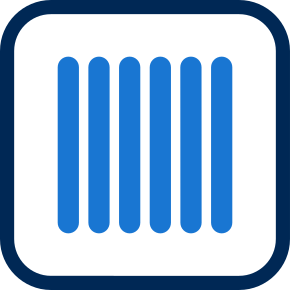
Grooving: Radial

Right-Hand / Left-Hand Helix

Cross Grooving
Transparency Is Part of the Service
That is why we present the process transparently – including typical options.
Capacity Is Good. The Right Capacity Is Better.
Specialized manufacturing instead of a one-size-fits-all process
Dimensions
Diameter up to Ø 1.000 mm
Length up to 14.000 mm
Unit weight up to 5.000 kg
Materials
Elastomer and polymer coverings
Engineered for a wide range of media, temperatures, and load conditions
Manufacturing
Specialized production areas for small, medium, and large rollers
Machining, clamping technology, and handling each tailored to the specific dimensions and material
Technical Support Beyond Manufacturing
Not every issue can be solved at the surface level. In some cases, the root cause lies in the material, in others in the process or the application. That is why application engineering support, laboratory analysis, and targeted knowledge transfer are available.
Frequently Asked Questions About Roll Manufacturing
What Information Is Required for a Reliable Quotation?
Roller type or machine, dimensions, application, and urgency. All further details are clarified in the subsequent technical assessment.
What Is the Difference Between Grinding Service and Re-Covering?
With grinding service, the existing covering is functionally restored. With re-covering, the old covering is removed and a new one is applied. The appropriate option depends on the roller condition and process requirements.
What Happens During Roller Core Inspection and Repair?
The roll core is inspected and, if required, repaired, for example at bearing seats or functional surfaces. This ensures that the new covering performs reliably over the long term.
Do You Handle Collection, Packaging, and Return Transport?
Yes. Collection, packaging, and return transport can be arranged and handled in full if required.
How Quickly Can Reconditioning Be Completed?
Lead time depends on urgency, dimensions, and the condition of the roller. Urgent cases without a replacement roller are prioritized, while preventive reconditioning can be scheduled in advance.

